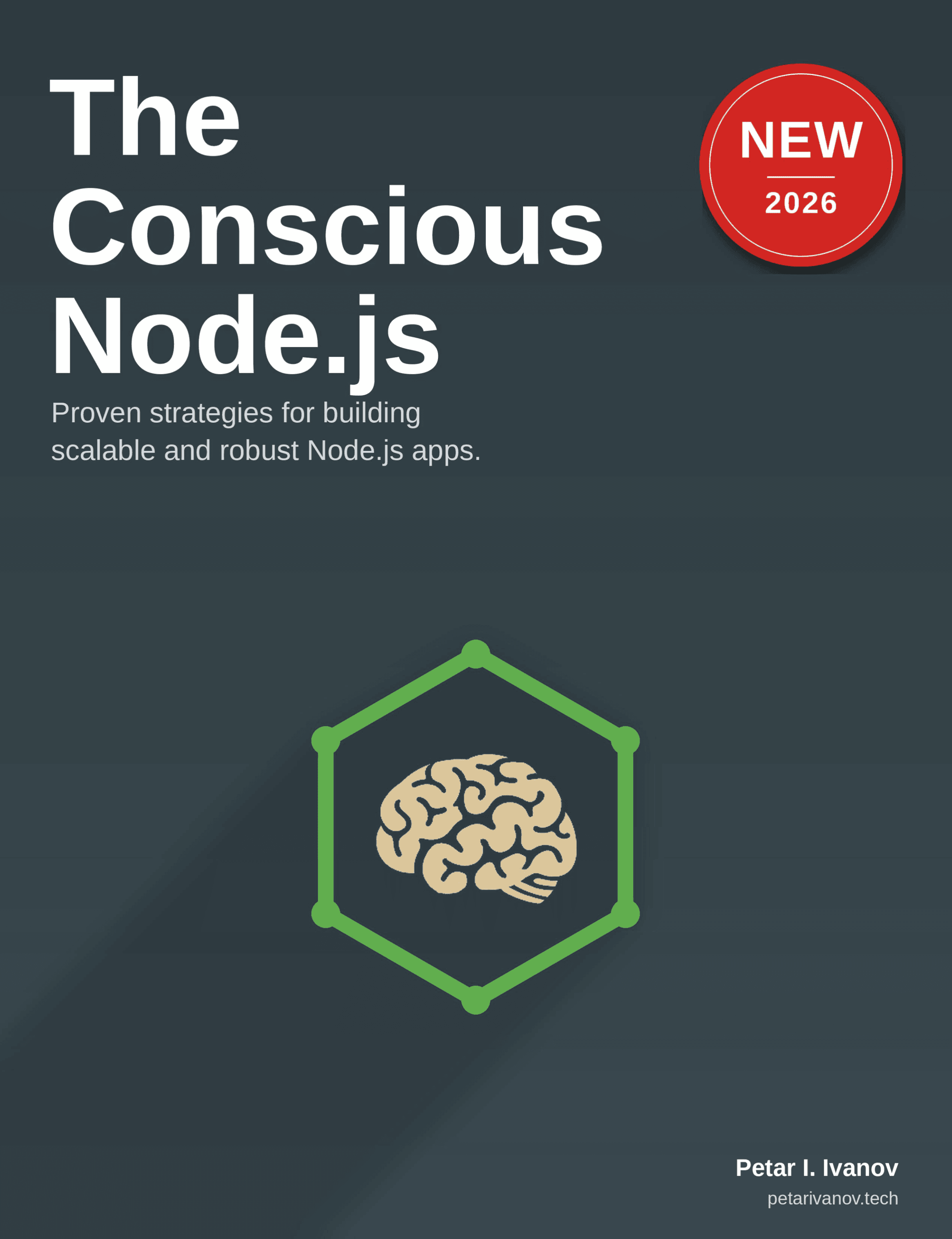
The Conscious Node
You build systems — not just endpoints.
For the developer who can already build a route — and now needs to build a system. 157 production tips for scalable Node.js services that survive ten engineers, three years, and two product pivots.
By Petar Ivanov — software engineer & architect
30,000+ engineers read The T-Shaped Dev · 75K on LinkedIn · 8+ yrs shipping Node.js at Fortune 500 cloud, finance & travel · GitNation & Geekle speaker
Why another book on Node.js?
Most Node.js content stops at “how does Express middleware work?”
The promotion-blocking question is the next one: “how should this codebase scale across ten engineers, three years, and two product pivots?”
That gap is the gap between a Node developer and a Node architect.
‘The Conscious Node’ is not a tutorial. It doesn't teach Node.js.
Instead, it combines software architecture, design, and clean code essentials with Node.js — helping you write scalable, testable and observable services from first principles.
157 tips across 10 chapters — module boundaries, repositories, the transactional outbox, structured logs, OpenTelemetry, Testcontainers, zero-downtime deploys — each in the same Context → Avoid → Prefer → Takeaway format. No theory cosplay. No contrived examples.
What other engineers say about my work
Read weekly by 30,000+ engineers on The T-Shaped Dev. Featured by fellow newsletter authors and senior engineers.

Petar teaches you the most important concepts you need to know in a practical, easy-to-understand way. I highly recommend subscribing 🔥

Great newsletter to help you level up as an engineer! Petar shares very practical insights in a very detailed and understandable way.

Petar is an incredibly versatile and experienced engineer. The T-Shaped Dev is your starting point no matter where you are in your SWE career.

Great for practical advice around modern web tech stacks.
Why this book?
Most Node.js resources teach you the how. We focus on the why.
Architecture & Domain Design
Module structure by domain (not by technical role), modular monoliths, layered services, hexagonal architecture, and the repository pattern at the data edge. Architecture that scales from side project to Fortune 500.
APIs, Data & Errors
REST + GraphQL with hypermedia, pagination, idempotency keys, persisted queries, DataLoader. Multi-layer caching, parameterized queries, transactional outbox. Operational vs. programmer errors, correlation IDs, graceful shutdown.
Performance & Production
Don't block the event loop — profile, measure, optimize. Multi-core utilization, Docker multi-stage builds, zero-downtime deploys, exponential backoff + jitter, circuit breakers (opossum), OpenTelemetry wiring, and the expand/contract migration pattern.
Security, Testing & Tooling
Zod validation at the boundary, Helmet, argon2id, rate limiting. A real test pyramid with the native runner, Testcontainers and Pact contract tests. ESLint, Biome, Husky, Renovate, pnpm — the 2026 tooling stack that keeps a codebase fast and consistent.
A peek inside.
10 Chapters. ~250 Pages. 157 Tips. 3 Companion Repos. No fluff — just the architectural decisions senior Node.js engineers actually make, drawn from years of production systems inside Fortune 500 cloud, finance, and travel teams.
Each tip is one continuous read: the problem you've felt (🧩 context), what to avoid (⛔), what to prefer (✅), and a one-line takeaway you can quote in your next code review.
Get 3 free tipsThree sample tips from the book, sent to your inbox as PDF & EPUB — no charge.
The Retry That Charges Your Customer Twice
Tip 6.13 — Make Writes Idempotent with an Idempotency-Key Header
Retried GETs are harmless — same data, everyone moves on. Retried POSTs aren't. A client submits “create order”, the response gets lost on the way back, the client retries — and now there are two orders for the same customer. Every retried POST is a duplicate-charge risk unless the endpoint is idempotent.
app.post('/api/v1/orders', async (req, res) => {
  const order = await placeOrder(req.body);
  // network drops the response —
  // client retries, second order created
  res.status(201).json({ data: order });
});// client sends a unique Idempotency-Key
// per logical operation
const stored = await db.idempotencyKeys
.findByKey(key);
if (stored) {
if (stored.requestHash !== requestHash) {
return res.status(409)
.json({ error: 'key reused, new body' });
}
// replay: same status, same body,
// operation never re-executes
return res.status(stored.statusCode)
.json(stored.response);
}Takeaway — Require an Idempotency-Key on every write with side effects: first request executes, duplicates replay the stored response. Charging a customer twice becomes structurally impossible — Stripe has run on this pattern for over a decade.
This is one tip. The book has 156 more — each in the same Context → Avoid → Prefer → Takeaway format.
Want three more like this? Get them free ↓Ten minutes of the book, on me.
Not a teaser — three more real tips like the one you just read, straight from Chapter 1 in the same Context → Avoid → Prefer → Takeaway format. If the way it thinks clicks for you, you'll know in ten minutes.
Drop your email and I'll send all three tips as a PDF and EPUB — read them anywhere, even on your Kindle.
- 1.1 — Structure the application in modules (the boundary decision every later chapter inherits)
- 1.2 — Start with a modular monolith (and skip the microservices tax you don’t owe yet)
- 1.3 — Create layers: routes → services → repositories (so business logic stops living in route handlers)
They look basic. That's the point — Chapter 1 is where most Node services have already gone wrong before the first endpoint ships.
After the tips, I'll only email when there's a new deep dive on the blog or a sale. Unsubscribe any time.
Read it this weekend. Ship differently on Monday.
Read the book, or clone the whole system. Either way you get lifetime updates as Node.js continues to evolve.
- The ~250-page 2026 edition in PDF, MOBI and EPUB formats
- 157 production tips across 10 chapters — architecture, APIs, data, errors, security, testing, performance, tooling
- Hands-on patterns: repository, transactional outbox, idempotency keys, circuit breakers, OpenTelemetry
- The 10 Rules of Senior Node — heuristics that survive any framework cycle
- Lifetime updates as Node.js continues to evolve
- The ~250-page 2026 edition in PDF, MOBI and EPUB formats
- book-examples repo — every tip as a runnable Avoid / Prefer demo, one file per tip
- case-studies repo — 6 deep-dive services: modular & hexagonal monoliths, CQRS + outbox, background jobs, GraphQL, observability
- express-boilerplate — production-ready Express 5 + TS starter (Kysely, Objection, Pino, OTel, Docker, CI)
- CLAUDE.md · AGENTS.md · .cursorrules in every repo, so Claude Code, Cursor & Copilot generate book-aligned Node code
- Lifetime updates as Node.js continues to evolve
30-day money-back guarantee
Read the book. Clone the repos. If it doesn't help you ship better Node.js, email me within 30 days and I'll refund every cent — no questions asked.
🔒 Secure payment powered by Stripe. Local taxes not included.
Frequently Asked Questions
No. The book is for developers who can already build a route and now need to build a system. It assumes you can stand up an Express or NestJS service — and focuses on the architectural decisions that come after: module boundaries, repositories, the transactional outbox, structured logs, OpenTelemetry, testing with Testcontainers, zero-downtime deploys.
If you can ship a feature end-to-end and now feel the codebase pushing back as it grows, yes — the book is for you. If you're still wiring up your first endpoint, you'll get more from a Node.js tutorial first, then come back when the team conversations start being about scaling, modeling, and reliability.
The patterns are framework-agnostic — module boundaries, repositories, idempotency, observability, retries, circuit breakers. They apply equally to Express, NestJS, Fastify, or Hono. The Complete Package ships a production Express 5 boilerplate plus six runnable case studies (modular & hexagonal monoliths, CQRS + transactional outbox, background jobs, GraphQL, observability) so you can see the same patterns wired up end-to-end.
All code examples are TypeScript with ESM (`node:` imports, arrow functions, async/await). You can apply the patterns to plain JavaScript, but TypeScript is recommended and the book has a chapter on why.
Currently, I only offer the digital version. If there is real demand for a print edition I may revisit it.
The book ships as PDF, MOBI and EPUB. The Complete Package adds three companion repos — book-examples, six deep-dive case studies, and the Express boilerplate — each with a CLAUDE.md, AGENTS.md and .cursorrules ruleset so Claude Code, Cursor and Copilot generate book-aligned Node code.
Ready to build with
absolute clarity?
Read it this weekend. Ship Node.js services that survive ten engineers, three years, and two pivots.
Purchase Now